Hundreds deployed in the IDF
Mission management
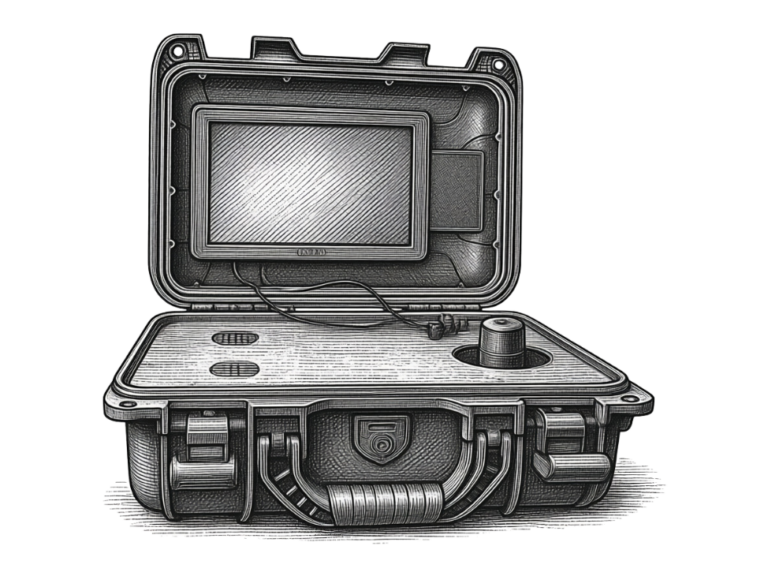
ReconOps
Portable mission management for multi-camera observation, analysis, and operator control.
View ReconOps
Mission environment
Visual monitoring of mine shafts, entrances and exclusion zones for site security, safety workflows and remote supervision.
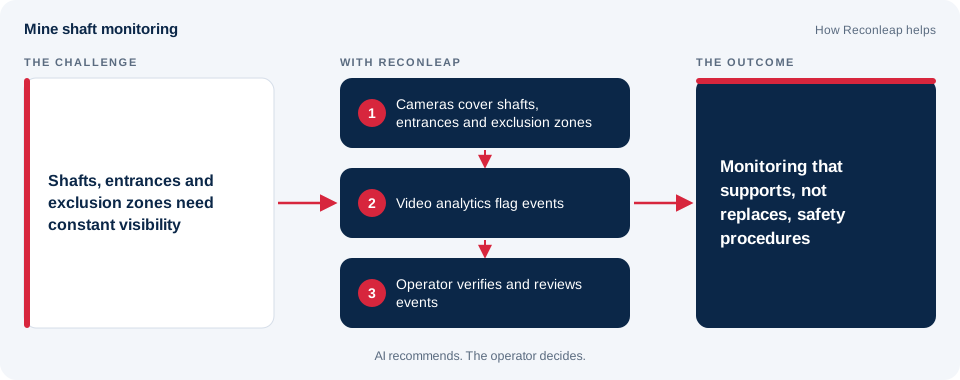
Mine shafts and underground entrances are places where access must be controlled. On active sites that means knowing who and what is near the shaft collar, the cage area and the access road. On closed or abandoned sites it means noticing when someone enters an area that is fenced off for good reason.
Mining sites are large, dusty and often remote. Staff are spread out, and many sites run with fewer people than they have places to watch. Mine shaft monitoring uses cameras and local analytics to support site security, safety workflows and remote supervision, so the people responsible can see what is happening and check it.
Monitoring supports safety procedures. It does not replace them. Visual monitoring and operational awareness do not replace mandated mine-safety procedures, certified gas detection, structural inspection, emergency protocols or qualified human safety supervision.
| Role | What they usually need |
|---|---|
| Mining and quarry operators | Awareness of shaft entrances, access roads and exclusion zones. |
| Site security teams and providers | Verified alerts for unauthorized entry and theft, without sending someone each time. |
| Safety and operations teams | A clear view of who and what is near restricted areas. |
| Environmental and remediation teams | Monitoring of closed or abandoned sites. |
| Government authorities | Awareness of restricted or abandoned mine sites. |
| Remote monitoring centers | Evidence-based alerts from many sites in one view. |
ReconOps provides portable mission management for multi-camera observation, analysis and operator control. ReconOS adds sensor fusion and AI-assisted prioritization for a unified operational picture. Read about the Technology behind this.
| Layer | What it does |
|---|---|
| Observe | Fixed and PTZ IP cameras cover shaft entrances, gates and access roads. |
| Process at the edge | Local analytics flag people and vehicles where supported, with limited bandwidth. |
| Prioritize | Events are ranked so the most relevant appear first. |
| Verify | The operator reviews evidence and can use a PTZ camera to look closer. |
| Record | Event clips are kept for incident review and reporting. |
The platform is configured to site conditions and operational requirements. No single sensor or AI model covers every scenario.
| Stage | What happens | Who acts |
|---|---|---|
| Detect | Local analytics flag a person or vehicle in or near a monitored area, where supported | The system |
| Verify | The operator reviews the evidence and can use a PTZ camera to look closer | The operator |
| Classify | The operator judges whether it is authorized work, routine traffic or an unauthorized entry | The operator |
| Alert | The right person is informed through the site procedure | The operator |
| Respond | Security or safety staff act according to site procedures | Your team |
| Document | The event clip is kept for review and reporting | The system and the operator |
| Capability | Operational value | Relevant scenario |
|---|---|---|
| Multi-camera observation | One view of several entrances and approaches | Shaft collars, gates, access roads |
| Person and vehicle detection where supported | Draws attention to activity in restricted areas | Closed shafts and exclusion zones |
| PTZ investigation | Clearer evidence before sending staff | Large sites with long sight lines |
| Geofenced areas of interest | Alerts tied to the zones that matter | Exclusion zones and temporary work areas |
| Local processing | Works with limited bandwidth | Remote and abandoned sites |
| Event clips and review | Fast incident review and reporting | Theft, entry and safety follow-up |
| Consideration | Why it matters | Recommended approach |
|---|---|---|
| Dust and vibration | They affect lenses and mounts | Choose housings and mounting suited to the site, and plan cleaning |
| Low light | Shaft areas and night shifts are often poorly lit | Plan camera types and lighting; thermal-capable cameras can be considered where a site already uses them |
| Power | Remote and closed sites may have none | Survey power early and plan around it |
| Communications | Links limit how video and events move | Use local processing and describe the network in a briefing |
| Moving equipment | Vehicles and people share the same areas | Draw areas of interest around the zones that matter |
| Access control | Footage is sensitive | Limit who can view it and follow your own policy |
| Retention | Rules differ between sites and regions | Agree retention and access rules before deployment |
| Area | Conventional approach | Integrated approach |
|---|---|---|
| Attention | Staff watch many feeds or patrol | Event prioritization points operators at what matters |
| Verification | Send someone to check | Review evidence and use PTZ first, then decide |
| Evidence | Search long recordings | Event clips ready for review |
| Existing cameras | Replace or run separate systems | Designed to work with fixed and PTZ IP cameras you already run |
| Decision | Depends on the available view | AI recommends. The operator decides. |
This table describes general approaches. Results depend on your site and configuration.
An active shaft entrance. The operator sees vehicles and people near the shaft collar and access road, and keeps clips for review.
An abandoned shaft on a remote site. Local processing keeps working on a limited link. The operator checks an alert with a PTZ camera before sending anyone.
A temporary work zone. An area of interest is drawn around the maintenance area and adjusted as the work moves.
These scenarios are illustrative examples of how the approach is used. They are not customer case studies.
Reconleap is designed to work with the cameras you already run, including fixed and PTZ IP cameras. How it connects to video management systems, alarm systems, maps or a remote operations center depends on your setup, and is scoped in a briefing. We do not list specific supported integrations on this page.
It is continuous observation of shaft entrances, access points and exclusion zones, so site teams can see what is happening and verify events.
No. It supports operational awareness. It does not replace mandated safety procedures, certified gas detection, structural inspection, emergency protocols or qualified safety supervision.
It can support monitoring of closed or abandoned sites where cameras can be installed. Power and network at the site affect what is practical, so describe them in a briefing.
Reconleap is designed to work with the cameras you already run, including fixed and PTZ IP cameras. Tell us what you have and we will help assess where it fits.
Dust and light affect what any camera can show. Plan housings, placement and lighting for the site, and treat detections as prompts for the operator to check.
Local processing keeps working. Your network layout still affects how video and events reach operators.
It can help operators notice and verify activity in restricted areas, and keep clips for review. It does not guarantee prevention.
No. AI recommends. The operator decides.
Related guide: see how AI video analytics for existing cameras helps your team check alerts instead of watching every screen.
Last reviewed October 2026.
Operational challenges
How it works
Local video analytics flag people and vehicles where supported.
The operator reviews clear evidence and can bring a PTZ camera to look closer.
Event clips are kept ready for review and reporting.
AI recommends. The operator decides.
Recommended capabilities
Multi-camera views of shaft entrances, gates and access roads.
Person and vehicle detection where supported, with evidence for the operator.
Look closer before sending staff.
Keeps working with limited bandwidth.
Clips ready for incident review.
Operational value
Event prioritization points operators at what matters.
Evidence and PTZ investigation help confirm an alert.
Fixed and PTZ IP cameras. No rip-and-replace.
Event recording keeps clips ready for review.
Deployment context
Used with ReconOps for multi-camera observation and operator control, and with ReconOS where sensor fusion and AI-assisted prioritization are needed. It supports operational awareness and does not replace mine-safety procedures, certified gas detection or qualified safety supervision.
Related products
See how Reconleap can connect sensing, edge intelligence, and human decision-making for your operational environment.