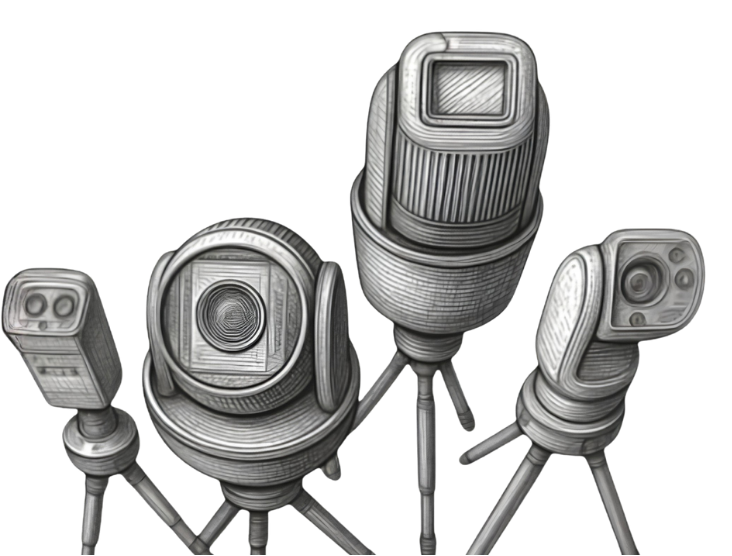
Hundreds deployed in the IDF
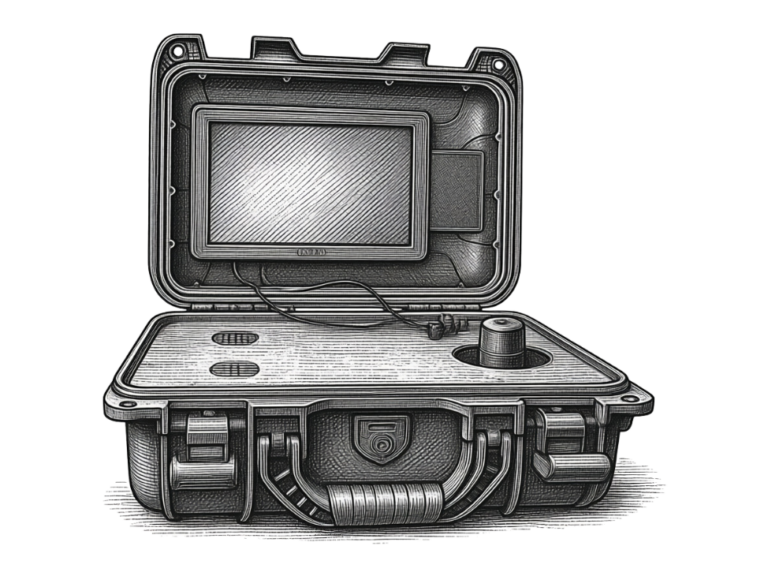
Mission management
ReconOps
Portable mission management for multi-camera observation, analysis, and operator control.
View ReconOps
Mission environment
Rapid deployment, distributed observation and multi-camera coordination, with the operator in control.
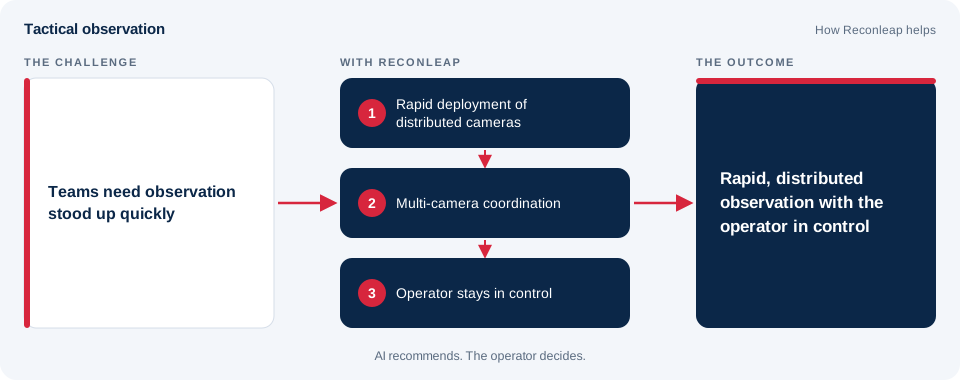
Tactical observation is the work of establishing and maintaining a clear view of an area for a team that has to act on what it sees. It usually happens in temporary or changing locations, where there is little time to set up and little infrastructure to rely on.
The difficulty is not a lack of cameras. It is turning several cameras and sensors into something one operator can follow. This page explains how rapid deployment, multi-camera coordination and operator control fit together. It covers observation, analysis and operator control.
| Role | What they usually need |
|---|---|
| Field observation teams | Observation that can be set up quickly and moved. |
| Team leads | One clear view across several cameras and sensors. |
| Operators | Prioritized events instead of a wall of video feeds. |
| Planners | A setup that works with limited connectivity and changing locations. |
A temporary observation area. A team needs a view of an area for a few days. Cameras are set up quickly, brought into one view and moved when the task ends.
Several cameras, one operator. Different cameras cover different parts of the area. Instead of watching each feed, the operator follows one prioritized picture and looks closer only where needed.
A move to a new location. The team relocates the next day. A setup built for portability is stood up in the new location and brought back into the same view.
These scenarios are illustrative examples of how the approach is used. They are not customer case studies.
| Approach | What it means | Trade-off |
|---|---|---|
| Watch each camera separately | The operator switches between individual feeds | Important events are easy to miss as the number of cameras grows |
| Multi-camera view | Cameras are brought into one coordinated view | Needs setup so that each camera is placed with a purpose |
| Prioritized events | Detections and events are ranked for attention | The operator still confirms what each event means |
| Question | Why it matters |
|---|---|
| What area needs to be observed? | This decides where cameras and sensors go. |
| Which cameras and sensors are available? | Existing equipment may be usable. |
| What power is available? | Power shapes how long equipment can run in place. |
| What connectivity will the team have? | Limited links favor local processing and efficient reporting. |
| How many operators and how often do they hand over? | Handover affects how the picture should be presented. |
| How soon might the setup move? | Frequent moves favor portable, simple deployment. |
ReconOps provides portable mission management for multi-camera observation, analysis and operator control. ReconOS adds sensor fusion and AI-assisted prioritization for a unified operational picture.
Read about the Technology behind them, and Field readiness for how the system works beyond fixed infrastructure.
Reconleap is designed to work with the cameras you already run. Tell us what you have and we will help assess where it fits.
Cameras and sensors are brought into one view, and detections and events are ranked so the operator can see what needs attention first.
It means added situational context for the operator. If you have a specific need, ask in a briefing and we will tell you what is supported. See the Airspace Awareness Support mission for more.
Rapid deployment and redeployment are part of the approach. Setup time depends on the site and equipment, so we do not publish a fixed figure.
The operator. AI recommends. The operator decides.
Related guide: see how AI video analytics for existing cameras fits a quick multi-camera deployment.
Last reviewed October 2026.
Operational challenges
How it works
Deploy cameras and sensing rapidly, and bring them online.
Bring multiple cameras and sensors into one coordinated view.
Detections and events are ranked so attention goes where it matters.
The operator stays in control. AI recommends. The operator decides.
Recommended capabilities
Stand up a sector, move it tomorrow.
Distributed observation in one view.
AI recommends. The operator decides.
Added situational context.
Operational value
Stand up a sector, move it tomorrow.
Multi-camera coordination and distributed observation in one picture.
AI recommends. The operator decides.
Situational context for the operator, including airspace awareness support.
Deployment context
Used with ReconOps for portable mission management across multiple cameras, and with ReconOS for sensor fusion and AI-assisted prioritization. This page covers observation, analysis and operator control.
Related products
See how Reconleap can connect sensing, edge intelligence, and human decision-making for your operational environment.