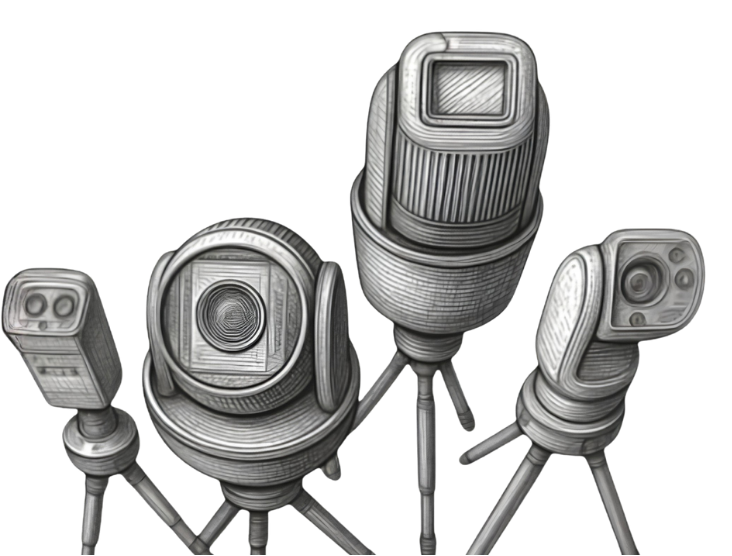
Hundreds deployed in the IDF
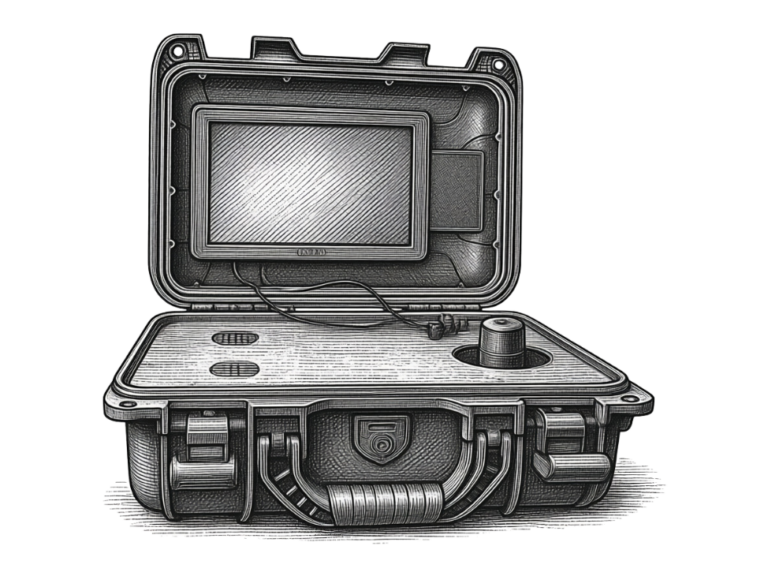
Mission management
ReconOps
Portable mission management for multi-camera observation, analysis, and operator control.
View ReconOps
Mission environment
Privacy-conscious monitoring of campground entrances, parking, facilities and perimeters, with verified alerts and event review.
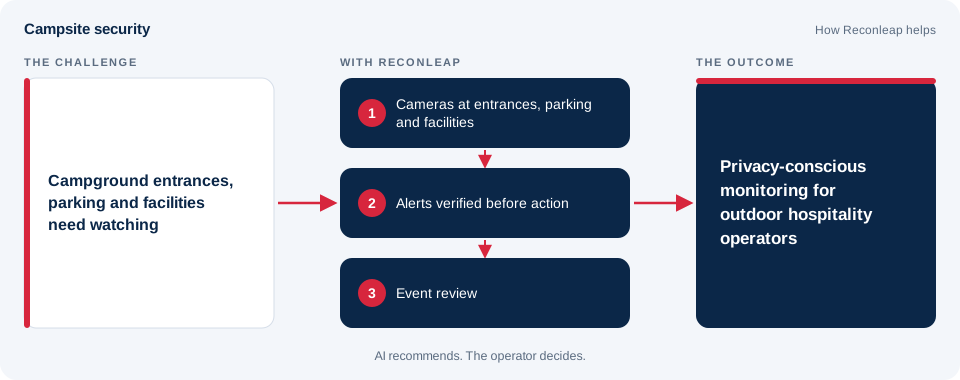
Campgrounds and outdoor hospitality sites are open by design. Guests come and go, vehicles use gates and parking areas, and facilities such as reception, shops and equipment stores sit among trees and tents. Campsite security is about protecting guests, vehicles and facilities without changing the outdoor experience people come for.
Many sites are remote, seasonal or lightly staffed, and some have limited power and network. After hours, a small team may have no easy way to check a gate or a storage area without walking out to it.
Reconleap supports this with camera observation of entrances, parking, facilities and perimeters, local analytics where supported, operator verification and event clips for review.
Monitor shared and approach areas, not private spaces. Cameras should not be installed in private accommodation interiors, bathrooms, showers, changing areas or other sensitive spaces.
| Role | What they usually need |
|---|---|
| Campground and glamping operators | Awareness of gates, parking and facilities after hours. |
| National parks and nature reserves | Monitoring of trailheads, access points and restricted zones. |
| Municipal recreation departments | Visibility of public outdoor areas. |
| Resorts, youth camps and event operators | Temporary or seasonal monitoring. |
| Security providers for outdoor hospitality | A layer that works with cameras already installed. |
ReconOps provides portable mission management for multi-camera observation, analysis and operator control. ReconOS adds sensor fusion and AI-assisted prioritization for a unified operational picture. Read about the Technology behind this.
| Layer | What it does |
|---|---|
| Observe | Fixed and PTZ IP cameras cover entrances, parking, facilities and perimeters. |
| Process at the edge | Local analytics flag people and vehicles where supported. |
| Prioritize | Events are ranked so the most relevant appear first. |
| Verify | The operator reviews evidence and can use a PTZ camera to look closer before acting. |
| Record | Event clips are kept for review under your retention rules. |
The platform is configured to site conditions and operational requirements. No single sensor or AI model covers every scenario.
| Stage | What happens | Who acts |
|---|---|---|
| Detect | Local analytics flag a person or vehicle in a monitored area, where supported | The system |
| Verify | The operator reviews the evidence and can use a PTZ camera to look closer | The operator |
| Classify | The operator judges whether it is a guest, staff, an animal or something unexpected | The operator |
| Alert | Site staff or security are informed through the agreed procedure | The operator |
| Respond | Staff act according to site procedures | Your team |
| Document | The event clip is kept for review under your retention rules | The system and the operator |
| Capability | Operational value | Relevant scenario |
|---|---|---|
| Multi-camera observation | One view across gates and shared areas | Entrances, exits and parking |
| Person and vehicle detection where supported | Draws attention to activity after hours | Storage areas and facilities |
| PTZ investigation | Clearer evidence before walking out at night | Wide outdoor areas |
| Geofenced areas of interest | Alerts tied to restricted zones | Trailheads and restricted areas |
| Local processing | Works with limited connectivity | Remote and seasonal sites |
| Event clips and review | Fast incident review | Theft or damage follow-up |
| Consideration | Why it matters | Recommended approach |
|---|---|---|
| Guest privacy | Guests expect privacy in accommodation and washing areas | Place cameras only on entrances, parking and shared facilities; use signage and privacy masking where available |
| Retention and access | Footage is personal data in many regions | Set retention limits and restrict who can view footage |
| Power | Remote sites may have no mains power | Survey power early; solar-powered setups can be considered where suitable |
| Connectivity | Links can be limited or seasonal | Use local processing and describe the network in a briefing |
| Wildlife and vegetation | Animals and wind trigger unwanted alerts | Draw areas of interest around the zones that matter and review before acting |
| Light and weather | Night and weather affect what cameras show | Plan placement for night viewing and weather |
| Legal review | Rules on surveillance differ by region | Review local law before deployment |
| Area | Conventional approach | Integrated approach |
|---|---|---|
| Attention | Staff patrol or watch recordings later | Event prioritization points operators at what matters |
| Verification | Walk out to check | Review evidence and use PTZ first, then decide |
| Evidence | Search long recordings | Event clips ready for review |
| Existing cameras | Replace or run separate systems | Designed to work with fixed and PTZ IP cameras you already run |
| Decision | Depends on the available view | AI recommends. The operator decides. |
This table describes general approaches. Results depend on your site and configuration.
A campground gate after hours. The operator reviews a clip of a vehicle at the gate and decides whether it needs a visit.
A remote glamping site. Cameras cover the entrance, parking and shared facilities only. Accommodation interiors are not monitored.
A seasonal site or a temporary event. A portable setup is installed for the season and areas of interest are adjusted as the layout changes.
These scenarios are illustrative examples of how the approach is used. They are not customer case studies.
Reconleap is designed to work with the cameras you already run, including fixed and PTZ IP cameras. How it connects to other security systems, maps or a monitoring center depends on your setup, and is scoped in a briefing. We do not list specific supported integrations on this page.
It is the monitoring of campground entrances, parking, shared facilities and perimeters so operators can protect guests and property without compromising the outdoor experience.
Not in private accommodation interiors, bathrooms, showers, changing areas or other sensitive spaces. Focus on entrances, parking and shared facilities.
Use signage, limited retention, restricted access to footage and, where available, privacy masking. Review local law before deployment.
It depends on the site. Power and connectivity shape what is practical, so describe them in a briefing. Local processing keeps working on limited links.
Local analytics detect people and vehicles where supported, and the operator confirms each event. Wildlife can still cause unwanted alerts, so areas of interest should be drawn with care.
Reconleap is designed to work with the cameras you already run, including fixed and PTZ IP cameras.
Yes. See the related missions for temporary and remote deployments.
No. AI recommends. The operator decides.
Related guide: see how AI video analytics for existing cameras helps your team check alerts instead of watching every screen.
Last reviewed October 2026.
Operational challenges
How it works
Local video analytics flag people and vehicles where supported.
The operator reviews clear evidence and can bring a PTZ camera to look closer.
Event clips are kept ready for review.
AI recommends. The operator decides.
Recommended capabilities
Multi-camera views of gates, parking and shared facilities.
Person and vehicle detection where supported, with evidence for the operator.
Look closer before walking out at night.
Keeps working on limited links.
Clips ready for review under your retention rules.
Operational value
Event prioritization points operators at what matters.
Evidence and PTZ investigation help confirm an alert.
Fixed and PTZ IP cameras. No rip-and-replace.
Event recording keeps clips ready for review.
Deployment context
Used with ReconOps for multi-camera observation and operator control, and with ReconOS where sensor fusion and AI-assisted prioritization are needed. Cameras should cover entrances, parking and shared facilities, not private accommodation or washing areas.
Related products
See how Reconleap can connect sensing, edge intelligence, and human decision-making for your operational environment.