
Mission environment
Wildlife Observation and Scouting
Observe wildlife from a distance, review what the cameras saw, and decide with a clear picture. Always follow local laws and licensing rules.
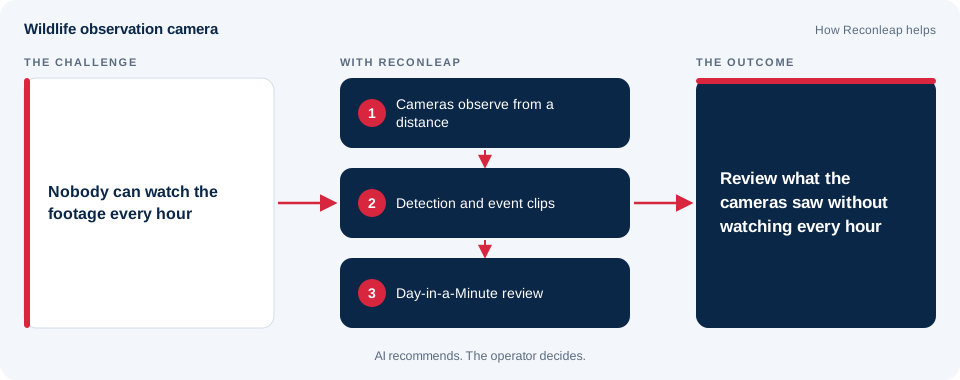
A wildlife observation camera lets you watch animals from a distance and review what happened without watching every hour. This page explains how detection, event clips and Day-in-a-Minute review fit together.
- Wildlife observation camera: what it involves
- Wildlife observation camera: who it is for
- Wildlife observation camera: example scenarios
- Ways to review footage
- Observation at different times of day
- Observing responsibly
- Wildlife observation camera: how Reconleap fits
- Frequently asked questions
- Related missions
Wildlife observation camera: what it involves
Wildlife observation and scouting is the practice of learning where animals are, when they are active and how they use an area, without disturbing them. People do it to manage land, understand habitat, enjoy the outdoors or plan where to spend time.
The practical problem is scale and timing. Large areas are hard to watch in person, much of the activity happens around dawn, dusk and night, and a few cameras can produce hours of footage that nobody has time to review. This page explains how observation from a distance and faster review can help.
Wildlife observation camera: who it is for
| Role | What they usually need |
|---|---|
| Landowners | Awareness of how animals use their land, without visiting every day. |
| Wildlife managers | Evidence of activity across large areas and different times of day. |
| Outdoor users | A way to observe from a distance and review what happened while away. |
Wildlife observation camera: example scenarios
A water point on a large property. Animals visit mostly around dawn and dusk. A camera at the water point records events, and the owner reviews short event clips instead of a full day of footage.
A habitat edge in remote terrain. There is no mains power and visits are infrequent. A solar-powered node observes from a distance, and the manager checks detections when they are next in range.
A seasonal pasture. The area is used for part of the year. The team positions equipment for the season, reviews a summary of each day and moves the equipment when the season ends.
These scenarios are illustrative examples of how the approach is used. They are not customer case studies.
Ways to review footage
| Approach | What it involves | When it fits |
|---|---|---|
| Watching raw recordings | Scrubbing through hours of footage by hand | Short periods or very few cameras |
| Event clips | Jumping to the moments flagged by AI-assisted detection | When activity is occasional and you want to see just those moments |
| Day-in-a-Minute review | Automated review of a selected time period | When you want a quick summary of a whole day or period |
In every approach the operator confirms what was seen. AI recommends. The operator decides.
Observation at different times of day
| Time of day | What usually changes | What to plan for |
|---|---|---|
| Dawn and dusk | Activity often peaks while light is low | Check how your setup performs in low light before relying on it |
| Daytime | Fewer visits in some areas, more people in others | Consider where people and animals overlap |
| Night | Activity continues but is hard to see | Review event clips rather than raw footage |
Observing responsibly
- Observe from a distance so animals are not disturbed.
- Always follow local laws and licensing rules for observation tools and for activity on the land.
- Be clear about who owns the land and who has permission to record there.
- Think about privacy if the area is used by people as well as animals.
Wildlife observation camera: how Reconleap fits
ReconOps provides portable mission management for multi-camera observation, analysis and operator control. Where there is no fixed power, ReconHop is a solar-powered observation node for remote terrain, with an operator-controlled PTZ camera to look closer.
Reconleap is designed to work with the fixed and PTZ IP cameras you already run. See Field readiness for how the system works beyond fixed infrastructure.
Frequently asked questions
Does it identify species automatically?
On this page, AI-assisted detection flags animals in the camera view and each detection is presented to the operator for visual confirmation of what was seen. If you need something more specific, ask in a briefing and we will tell you what is supported.
What is Day-in-a-Minute review?
It is an automated review of a selected time period that condenses a day of activity into a short review, so you can see what happened without watching everything.
Can I use cameras I already have?
Reconleap works with fixed and PTZ IP cameras. There is no rip-and-replace. Tell us what you have and we will help assess where it fits.
Does it work without mains power?
Solar-powered ReconHop nodes are designed for places where there is no fixed power. Site conditions affect what is practical, so describe the location in a briefing.
Does the equipment disturb animals?
Observation from a distance with a long-range PTZ camera is part of the approach. Always follow local laws and guidance on observing wildlife.
Who decides what a detection means?
You do. AI recommends. The operator decides.
Related missions
Related guide: learn how edge AI video analytics turns hours of footage into the events worth reviewing.
Last reviewed October 2026.
Operational challenges
What teams are up against
- Large areas are hard to watch in person
- Activity happens at dawn, dusk and night
- Hours of footage take too long to review
How it works
From detection to decision
-
Detect
AI-assisted detection flags animals in the camera view.
-
Identify
Each detection is presented to the operator for visual confirmation of what was seen.
-
Review
Event clips and Day-in-a-Minute summaries condense a day of activity into a short review.
Recommended capabilities
How Reconleap helps
-
Local recording and event clips
Evidence and footage kept on site.
-
Day-in-a-Minute review
Automated review of a selected time period.
-
Operator-controlled PTZ
Look closer at what was detected.
Operational value
What it changes for the team
-
See without disturbing
Observe from a distance with a long-range PTZ camera.
-
Works with your cameras
Fixed and PTZ IP cameras. No rip-and-replace.
-
Off-grid ready
Solar-powered ReconHop nodes where there is no fixed power.
-
You decide
AI recommends. The operator decides.
Deployment context
Deployed with ReconOps, or with solar-powered ReconHop nodes in remote terrain. Users are responsible for complying with local laws on observation tools.
Build a clearer operational picture.
See how Reconleap can connect sensing, edge intelligence, and human decision-making for your operational environment.